Migrate K9 Finance DAO to Arbitrum (Settlement + Treasury) and Relaunch with Yield Vaults + DAO-Owned Liquidity Tooling
Summary
This proposal requests DAO approval to:
-
Select Arbitrum as K9’s migration chain, establish it as the canonical operational chain for the DAO, and mint the missing/stolen 23% KNINE on Arbitrum for eligible claimants (excluding known hacker/blacklisted holdings).
-
Move operational treasury custody to Arbitrum (where feasible), with updated controls, reporting, and risk policies.
-
Submit a grant application to Arbitrum DAO (New Protocols and Ideas RFP) to fund the migration/relaunch work and reduce treasury burden.
-
Relaunch K9 with two revenue workstreams that do not rely on native chain staking:
- Yield Vaults built on established Arbitrum DeFi primitives.
- Liquidity Management + DAO-Owned Liquidity (DoL) Tooling to stabilize KNINE liquidity and generate DEX fee revenue.
This is a migration and revenue reset proposal. It is not a commitment to revive Bonecrusher or to pursue liquid staking on Arbitrum as a “native staking receipt token” model.
Background and Problem Statement
Following the Shibarium bridge incident and the subsequent strategic decision to exit Shibarium operations, K9 Finance DAO requires:
- A credible canonical chain to re-home KNINE liquidity and operations.
- A settlement mechanism to address the missing 23% KNINE associated with the bridge incident.
- A sustainable revenue model that fits tighter budget realities and restores long-term viability.
- A path that reduces execution risk, minimizes ongoing costs, and rebuilds confidence through transparency and measurable progress.
Arbitrum is being proposed because it offers strong EVM compatibility (low-friction redeploy), mature infrastructure, deep DeFi composability, and an active ecosystem grants path that may materially reduce DAO expenditure.
Proposal Scope
A) Migration and Settlement on Arbitrum
Goal: Establish Arbitrum as K9’s operational home and restore circulating supply integrity by minting the missing 23% KNINE on Arbitrum for eligible claimants.
Key components:
-
Canonical KNINE on Arbitrum
- Deploy KNINE contract(s) on Arbitrum.
- Establish official canonical references (docs, announcements, explorers, verified contracts).
- (Optional) Preserve matching contract address only if technically feasible and low-risk; not a requirement.
-
Eligibility and Claims (Mint of Missing 23%)
- Produce an eligibility dataset (snapshot + proofs) defining who is entitled to replacement tokens.
- Implement a claims contract (e.g., Merkle-claim or equivalent) to distribute minted KNINE on Arbitrum to eligible holders.
- Explicitly exclude known hacker/blacklisted holdings and any addresses determined ineligible under the DAO-approved policy.
-
Liquidity Re-establishment
- Bootstrap at least one primary KNINE liquidity venue on Arbitrum as part of the DoL workstream (see Section C).
Policy note: This proposal is framed around “minting the missing 23% on Arbitrum” as a settlement measure. It does not require re-opening or relying on any Shibarium bridging mechanism.
B) Treasury Migration to Arbitrum
Goal: Move operational treasury custody to Arbitrum (to the maximum extent feasible), with improved controls and reporting.
Key components:
-
Treasury assets moved to DAO-controlled multisig(s) on Arbitrum.
-
Define and publish:
- signers, thresholds, and signer rotation policy,
- spend authority boundaries,
- emergency procedures,
- transparency/reporting cadence.
-
Any assets not immediately movable (due to bridge status, custody constraints, or other limitations) will remain tracked, disclosed, and handled under an explicit plan approved by governance.
C) Relaunch Revenue: Yield Vaults + DoL Tooling
K9’s post-migration revenue strategy will be built around two complementary workstreams:
Workstream 1: Liquidity Management + DAO-Owned Liquidity Tooling (DoL)
Objective: Stabilize KNINE markets and generate recurring fee revenue (DEX fees) while minimizing treasury risk.
Deliverables:
-
A DAO-approved Liquidity Mandate defining:
- allowable venues/pools,
- treasury exposure limits,
- rebalancing rules,
- transparency requirements,
- emergency unwind procedures.
-
Execution of DoL on Arbitrum under the mandate.
-
Public reporting (positions, fees, actions log, and risk metrics).
Workstream 2: Yield Vaults on Existing DeFi Primitives
Objective: Build fee-generating products quickly and conservatively by composing established Arbitrum DeFi protocols.
Principles:
- Start with one vault (v1), one strategy, strict caps, conservative risk posture.
- Avoid complexity and leverage unless separately approved by governance.
- Prefer minimal contract surface and well-understood integrations.
Candidate vault categories (to be finalized post-approval under a separate “Vault v1 Selection” post if desired):
- stablecoin lending vault,
- LP fee capture vault,
- ETH LST/LRT yield strategy vault (only if risk controls and integration readiness are strong).
Revenue:
- Protocol fee model (management/performance fee) routed to the DAO, parameters governed and transparent.
Arbitrum Grant Application
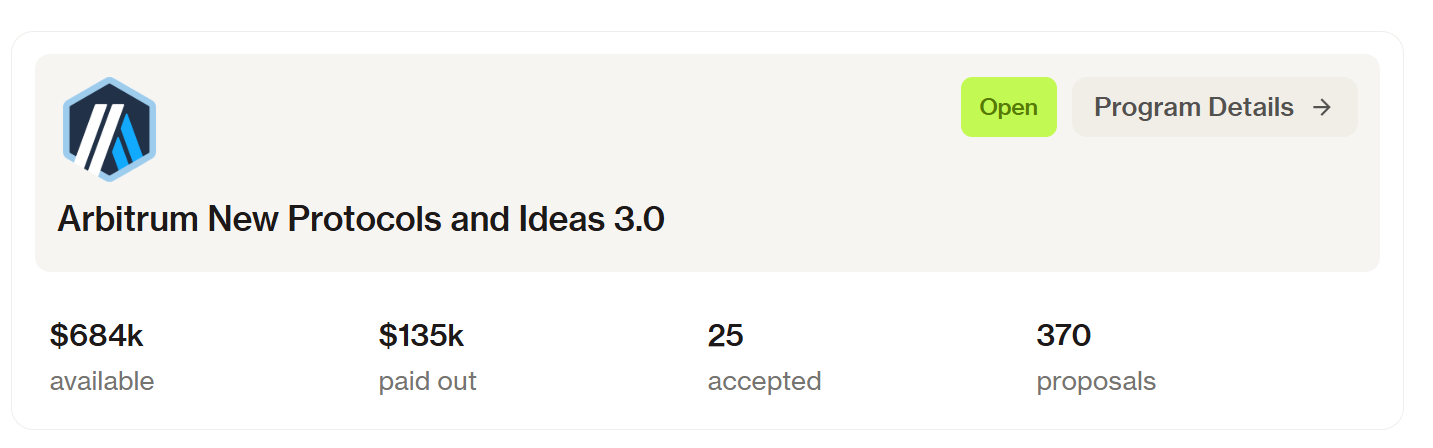
Action requested: Authorize a selcted team to submit a grant proposal to Arbitrum DAO under the relevant RFP track (New Protocols and Ideas).
Grant narrative focus:
- “K9 migration + settlement tooling + liquidity stabilization + fee-generating vaults” as a measurable Arbitrum ecosystem contribution.
- Milestone-based deliverables with clear KPIs (liquidity depth, volume, vault TVL, unique users, integrations).
Important: Grant funding is not guaranteed. This proposal does not assume approval; it authorizes the DAO to pursue it to reduce treasury spend.
Implementation Plan (Milestone-Based)
No fixed dates are promised; execution proceeds by completing milestones and publishing proof-of-work deliverables.
Milestone 1 — Governance & Controls
- Arbitrum confirmed as migration chain.
- Multisig(s) and operational roles confirmed/updated.
- Treasury policy + transparency cadence published.
Milestone 2 — Settlement Build
- Eligibility methodology published (snapshot source, exclusions, appeal/verification process if adopted).
- Claims contract implemented and independently reviewed.
- Public documentation for claimants.
Milestone 3 — Settlement Live
- Mint the missing 23% KNINE on Arbitrum into the claims mechanism.
- Claims go live with public dashboards.
Milestone 4 — Liquidity Mandate + DoL Live
- Liquidity mandate approved and enacted.
- Primary KNINE liquidity position(s) established.
- Reporting begins (fees, depth, exposure, actions log).
Milestone 5 — Yield Vault v1
- Vault v1 selection finalized under DAO oversight.
- Vault deployed with conservative caps and monitoring.
- Public documentation and risk disclosures published.
Milestone 6 — Grant Submission and Follow-through
- Grant application submitted.
- If approved: milestone reporting and execution aligned to grant terms.
Security, Risk, and Mitigations
Key risks and planned mitigations:
- Smart contract risk: Minimize custom logic; prioritize audited patterns; independent review before claims/vault release; strict caps; emergency pause/unwind.
- Operational risk: Clear signer roles, thresholds, separation of duties, change logs, and incident playbooks.
- Liquidity risk (IL / concentration): DoL mandate with exposure limits, pool selection criteria, and frequent transparency reporting.
- Reputation risk: Explicit separation of “migration settlement” from “new product revenue strategy,” and continuous public reporting.
Success Criteria (High-Level KPIs)
- Claims system executes reliably and transparently; eligible users can claim with reasonable UX.
- KNINE liquidity on Arbitrum achieves healthy depth and functioning price discovery.
- DoL generates measurable DEX fee revenue under transparent policy constraints.
- Yield Vault v1 launches safely with conservative risk controls and begins generating protocol fees.
- Grant application submitted with clear milestones/KPIs; if awarded, reduces treasury burden.
Requested Governance Actions (What You’re Voting On)
This proposal seeks approval to:
-
Select Arbitrum as the migration chain and treat Arbitrum as the DAO’s canonical operational chain going forward.
-
Mint the missing 23% KNINE on Arbitrum for settlement distribution via a claims mechanism, excluding hacker/blacklisted/ineligible holdings under the published policy.
-
Move operational treasury custody to Arbitrum under updated multisig controls and transparency policies.
-
Authorize submission of an Arbitrum DAO grant application to fund migration + DoL + Yield Vault delivery.
-
Authorize building:
- Liquidity management + DAO-owned liquidity tooling (DoL), and
- Yield vaults on existing primitives,
under a conservative risk framework and transparent reporting.
Budget (proposed, realistic, governance-ready)
Execution budget (one-time spend cap): Approve up to $250,000 USDC in total one-time operating expenditure to deliver (i) Arbitrum migration + canonical KNINE deployment, (ii) the 23% settlement mint + claims system, (iii) treasury migration hardening/monitoring, (iv) initial DoL ops tooling + reporting, and (v) Yield Vault v1 (built on existing primitives), including at least one independent security review/audit for the claims system and the vault contracts. Any spend above $250,000 requires a separate DAO vote.
Suggested internal allocation (within the $250k cap, adjustable by multisig within mandate):
- Settlement (snapshot/proofs + claims contracts + security review): up to $90,000
- Yield Vault v1 build + security review: up to $120,000
- DoL ops tooling, dashboards, reporting, monitoring: up to $40,000
- Grant application support: up to $5,000 (often $0 if in-house)
Liquidity capital (not “spend,” but treasury at risk): Authorize a pilot DAO-Owned Liquidity deployment up to $250,000 (or 15% of liquid treasury, whichever is lower) under a DAO-approved Liquidity Mandate (venues, exposure limits, rebalancing rules, and emergency unwind procedures). Liquidity principal remains DAO-owned; returns/losses come from market performance (fees/IL/price).
Incentives (optional, separate control): If incentives are used (DEX incentives, campaigns), cap at $50,000 total unless a separate DAO vote approves more. Incentives must be time-boxed and reported with ROI metrics.
Expected run-rate after launch: $10,000–$25,000 per month for ongoing monitoring, reporting, minor maintenance, and operational security (can be reduced if tooling is minimal and contributors are partially volunteer-based).
Grant offset: The DAO will submit an Arbitrum grant application; any grant awarded will reduce net treasury spend for the above deliverables but is not assumed in this budget.
Notes / Out of Scope
- This proposal does not commit to relaunching Bonecrusher.
- This proposal does not assume any Shibarium bridge remediation outcome.
- Detailed vault strategy selection, fee parameters, and incentives (if any) can be finalized in subsequent votes, if the DAO prefers.